
Six of the seven cases before the planning committee on Wednesday are there only because a town or parish council objected. That trigger goes on 31 October.
Seven planning applications go before New Forest District Council’s planning committee on Wednesday morning. Six of them are there for one reason: a town or parish council disagreed with the planning officer.
From 31 October, that reason stops working.
The committee is being asked on 9 September to endorse a new scheme of delegation that the council does not want and cannot refuse. Its own report calls the change an erosion of democratic oversight. It also says there are “no options to consider”.
What is actually changing
The Planning and Infrastructure Act 2025 gave the Secretary of State power to prescribe what planning committees in England are allowed to decide. The detail arrived in the Town and Country Planning (Discharge of Local Planning Authority Functions) (England) Regulations 2026, made on 15 July 2026 and coming into force on 31 October 2026.
The regulations sort every application into one of two schedules.
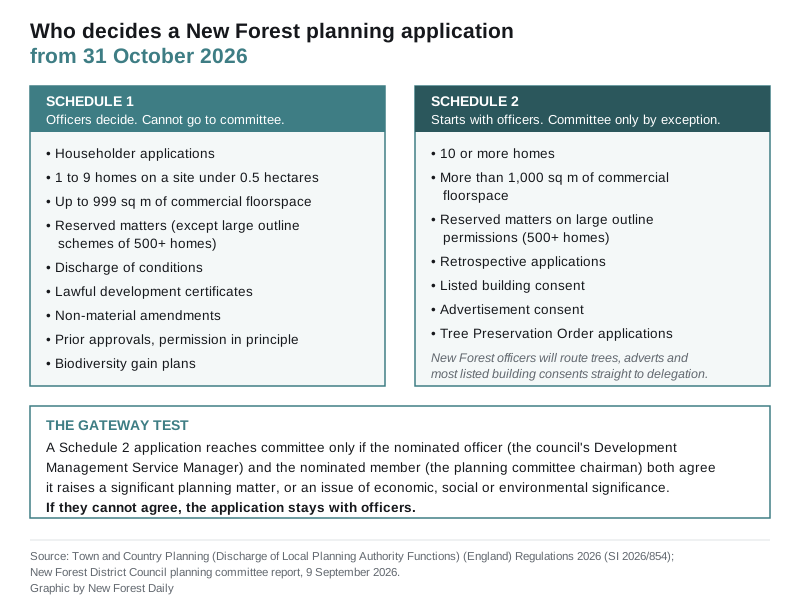
There are no transitional provisions. The regulations apply to every decision taken from 31 October, including on applications submitted long before that date. The council’s report warns that a decision taken outside the new rules would be open to judicial review and could be quashed.
The example on Wednesday’s own agenda
Item 3a is Wheelwrights Post on Salisbury Road at Burgate, north of Fordingbridge. It is an application for three dwellings and a new access on 0.19 hectares of garden land. Officers recommend approval.
The report gives one reason for it being at committee at all: “Town Council contrary view”. Fordingbridge Town Council resolved to recommend refusal, saying the site was being overdeveloped and that another access onto the A338 close to existing ones would harm highway conditions.
Three homes on 0.19 hectares is a “minor residential application” under the regulations, which define that as one to nine dwellings on a site smaller than half a hectare. That puts it squarely in Schedule 1. After 31 October, an identical application could not be referred to the committee by anyone, whatever the town council said.
The same is true of item 3d, a garage conversion at 7 Kingfisher Drive in Burgate that officers want to refuse, and item 3f, a set of extensions at 4 Roberts Road in Hythe. Both are householder applications, the first category on the Schedule 1 list.
Parish and town councils lose their trigger
New Forest parish and town councils currently answer planning consultations using five set responses, PAR1 to PAR5. Two of them, PAR3 and PAR4, recommend permission or refusal outright. If officers then took a different view, the application went to committee automatically.
The report is blunt about what happens next:
- the PAR1 to PAR5 categories will no longer apply in the district council’s planning area
- a parish or town council comment can no longer trigger an automatic referral
- councillors lose the power to call an application in, which the report describes as a nationwide removal
- the parish briefing notes that support the current process are up for review as well
Officers must still consider what parish and town councils say, and the report is careful to state that the weight given to their comments does not change. What changes is that saying it no longer gets anyone in front of the committee.
Two people now decide what the committee sees
For Schedule 2 applications, the route to committee runs through a “gateway test”. Two people have to agree, and the council is proposing who they are:
- nominated officer: the Service Manager for Development Management, with Development Management Team Leaders as substitutes
- nominated member: the chairman of the planning committee, with the vice chairman as substitute
They will meet roughly fortnightly, in what the council is calling a gateway meeting, with the case officer present and a short written briefing note prepared during the 21-day publicity period. If the two cannot agree, the application stays with officers. Every decision has to be recorded with its reason, published on the application file, and reported back to the committee in a list published with its agenda.
The council also proposes to triage some Schedule 2 work straight to officers before it ever reaches a gateway meeting. That covers tree preservation order applications, advertisement consent, and most listed building consent, unless a statutory consultee objects or the building is Grade I or Grade II*.
Half the committee’s caseload, gone
The council has measured the effect on itself. Roughly half of the items the planning committee has considered would fall into Schedule 1 and be delegated to officers outright. The report gives the period twice and inconsistently, as since January 2026 in one paragraph and since January 2025 in another, but the proportion is the same in both.
The other half would be Schedule 2, which means starting as delegated and needing to pass the gateway test.
On committee size the district is already compliant. The regulations cap a planning committee at 13 members. New Forest has 12, so nothing changes there.
The council objected and was told no
Full council agreed unanimously on 14 July 2025 to oppose the reforms. The Leader wrote to the Deputy Prime Minister on 22 July 2025, saying the changes would be an unacceptable erosion of democratic oversight and would risk undermining public trust in the planning system. The Ministry of Housing, Communities and Local Government replied on 18 August 2025, acknowledging the concerns and proceeding anyway.
The report says members will “no doubt maintain their concern and disappointment”, and then recommends adoption, because the alternative is unlawful decisions.
It also flags a risk in plain terms: that parish and town councils used to the current system, and residents who comment on applications, will feel their voice is not being listened to.
The National Park is exempt, and that splits the district
The legislation expressly excludes National Park Authorities. Applications inside the New Forest National Park are decided by the National Park Authority, and nothing about those changes.
Applications in the rest of the district are decided by the district council, and everything above applies to them. Several parishes are cut in two by the National Park boundary, so from November two houses in the same parish could sit under different rules depending on which side of the line they stand. Officers and the National Park Authority have written jointly to the parish and town councils affected.
What it means for you
- If you object to a neighbour’s extension or a small housing scheme, your parish or town council can no longer get it in front of councillors. From 31 October a planning officer decides, and the only route after that is an appeal by the applicant or a judicial review of the process.
- Nothing changes before 31 October. Wednesday’s meeting still runs under the current rules, and so does the October meeting.
- Comments still count. Officers have a legal duty to consider material planning objections. Write about planning matters such as highway safety, overlooking, drainage or heritage, not about the applicant.
- You can check what was refused a hearing. The council has committed to publishing the gateway briefing note on each application’s file and reporting a list of gateway decisions to the planning committee. If your case never reached committee, there should be a published reason.
- Watch the 12 October council meeting. The constitutional changes, including the final officer delegations, go to full council that day.
The Secretary of State must review the regulations and publish the findings by 31 October 2028.
The papers
- Planning Committee agenda, 9 September 2026, New Forest District Council. Item 4 is the delegation report, with the draft constitution changes at Appendix 1, the triage protocol and gateway test at Appendix 2, and the officer briefing note format at Appendix 3.
- The Town and Country Planning (Discharge of Local Planning Authority Functions) (England) Regulations 2026, SI 2026 No. 854.
The meeting starts at 9am on Wednesday 9 September in the council chamber at Appletree Court, Beaulieu Road, Lyndhurst.
More local information: New Forest planning news, council tax bands and bin collection days.
Have your say